Cloud egress fees mean a provider can charge you to take your own data out, whatever the label says. The word hiding the catch is “free”: the document behind a free-exit offer needs approval first, sets a deadline, and credits the data you stored, once. Anything beyond that is yours to pay. The standard should be plain: exit is free, all of it, with no approval step.
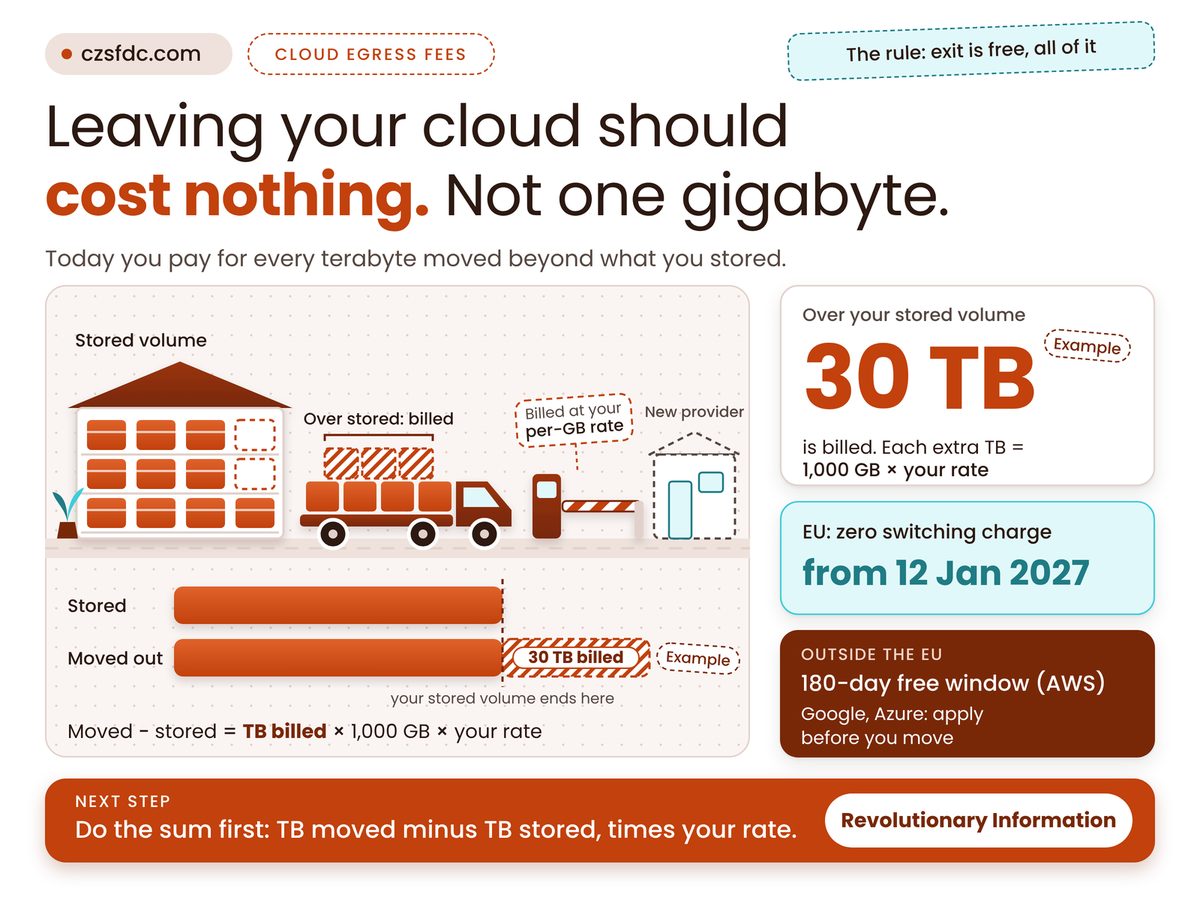
Exit should be free, and only the EU has made it a duty.
- From 12 January 2027, EU Regulation 2023/2854 (Article 29) bans switching charges outright.
- Elsewhere a free exit is a vendor promise: approval first, then a window.
- Decision rule: if the terabytes you move exceed the terabytes you store, every extra one is billed at your own per-GB rate.
Why it matters: do cloud egress fees still trap you?
Yes, outside the EU a free exit is a favor with strings attached, because the provider approves it first and, on the CMA’s 2025 reading, the credit covers only the data you stored, once.
The objection is fair: moving bytes costs a provider real money. The EU heard it. Article 29(2) allowed “reduced switching charges” from 11 January 2024, capped at costs “directly linked to the switching process concerned”. Then Article 29(1): from 12 January 2027 providers “shall not impose any switching charges on the customer for the switching process”. Plain reading: a cost-based bill for three years, then nothing. Our view: lawmakers priced the objection and still chose zero. A written floor beats a promise, as with audit log retention.
For a US team the picture is thinner. This research found no federal rule on exit charges (our reading, not legal advice), so you have policy (call it a courtesy), and either can be withdrawn. AWS’s program page, updated October 2026, says to contact Support and ask for free transfer-out rates; it warns of “additional scrutiny” on repeat requests. The term that sets your cost lives in a document, not on the label, like end-of-support dates in a footnote.
Four figures decide whether your exit is free. The window is from AWS’s program page (October 2026); the allowance, from its S3 pricing page (as of November 2026). The credit ratio is the CMA’s 2025 reading of AWS’s terms.
Free Window Outside the EU
180 days
Longer moves must notify Support
EU Switching Charge From 2027
$0
Law, not vendor goodwill
Free Transfer Out Each Month
100 GB
Routine traffic above it is billed
Free Transfer per Stored Data
1 : 1
Extra copies may be billed
The window is a project deadline, not a courtesy. AWS says to tell Support at once if you need longer. Plan slack before you ask.
Free to leave, if you ask first and move no more than you stored. That is a favor, not a standard.
Does AWS charge you to leave? The waivers side by side
Yes, unless you qualify: AWS, Google and Microsoft each waive transfer-out charges for a qualifying exit, but only after approval, inside a window, and on terms that differ by provider and by country.
Google announced its waiver on 11 January 2024, the day Article 29(2) starts its reduced-charge period; AWS followed on 5 March 2024 and Microsoft on 13 March 2024 (CMA Appendix N, 2025). Our reading: the offers arrived with the law, not out of generosity.
| Who you leave | The rule and its date | What it means for you |
|---|---|---|
| ⚖️ EU law | Zero charge from 12 Jan 2027 | Ask for the cost breakdown until then |
| 🌍 UK | Contract addendum, window extended | A contract term, still untested |
| 🧾 AWS outside EU | Support approves first | Re-syncs above stored volume may bill |
| 60 days, exit form first | Full exit expected; partial moves reviewed | |
| 💰 Azure | Storage only, 60-day credit cap | Credit arrives after the move ends |
Which of your exits is a right and which is a favor: only the EU card is a legal duty. Our derivation from Article 29, the CMA’s October 2026 update and its 2025 Appendix N.
Google and Azure rows use the CMA’s 2025 text. Our reading: only the first row is law, and every other row starts with a request you must make.
Worked example: a US team stores 120 TB on AWS. It copies everything once, then runs both clouds side by side and re-syncs 30 TB more, so 150 TB leaves. Assume $0.09 per GB, the rate AWS’s own VPC pricing page uses in an example (as of November 2026); type your own from your invoice. Assume the credit covers stored data once, as the CMA read it in 2025. Uncovered: 30 TB x 1,000 GB x $0.09 = $2,700. With no waiver the bill would be $13,500, so the waiver is worth $10,800. That is the Exit bill: (TB transferred - TB stored) x 1,000 x your $ per GB. Our assumptions and arithmetic, not an AWS quote; real rates fall at volume.
Friction points: where a free exit still bills you
A free exit still bills you when you move more than you stored or ask for it twice, because each waiver is a conditional credit, not a price of zero.
Terms drift, and the drift is documented. In 2025 the CMA recorded AWS terms with a window of 60 to 90 days (its documents differ) and a duty to delete remaining data or close the account. The AWS page, updated October 2026, requires no closure. Better. But the CMA also quoted AWS: “AWS may make changes with respect to free data transfers out to the internet at any time”. A rule would not carry that sentence.
The UK is stronger on paper. The CMA’s 16 October 2026 update says AWS and Microsoft wrote free-switching terms into UK contracts and moved UK multi-cloud transfers to at-cost pricing. Its Board reviews progress in spring 2027. A US customer has no statute and no review date; who has made the SMS OTP ban law shows what a mandate looks like.
- Parallel runs and re-syncs count as transfer: the credit follows stored volume (CMA, 2025).
- On an EU contract, read the provider’s EU Data Act addendum first; AWS points to section 2.3.
Check these before you request a free exit
- Your plan copies more than it stores.
- This account has asked for a free exit before.
- You are on Google or Azure and have not filed the form.
- Your cutover could outrun the window.
This week, write down two numbers from your console: terabytes stored, and terabytes you will transfer, re-syncs included. Do your Exit bill: if the second is larger, you owe the difference at your own per-GB rate, so shorten the parallel run until they match. Request approval in writing on AWS’s program page first; Google and Azure use their own forms. The call is wrong on an EU contract after 12 January 2027, and wherever terms have changed since November 2026.
How we checked this
We read Regulation (EU) 2023/2854 on EUR-Lex, the CMA’s cloud update of 16 October 2026, its 2025 Appendix N and AWS’s program page (updated October 2026). The worked example assumes 120 TB stored, 150 TB moved and an example rate of $0.09 per GB. No product was tested hands-on for this article. Last verified: 25 November 2026. Edited by Sheftali, reviewed after publication. Spotted something out of date? Tell us and we will correct it.
No comments
Post a Comment