Here is the rule: when a support bot cannot settle a payment dispute, a person must review it, on request. No law makes ad platforms follow it, and the ad account refund below shows the cost. The objection is that humans cannot scale. But the rule bites only after the bot fails, a far narrower duty than staffing every chat.
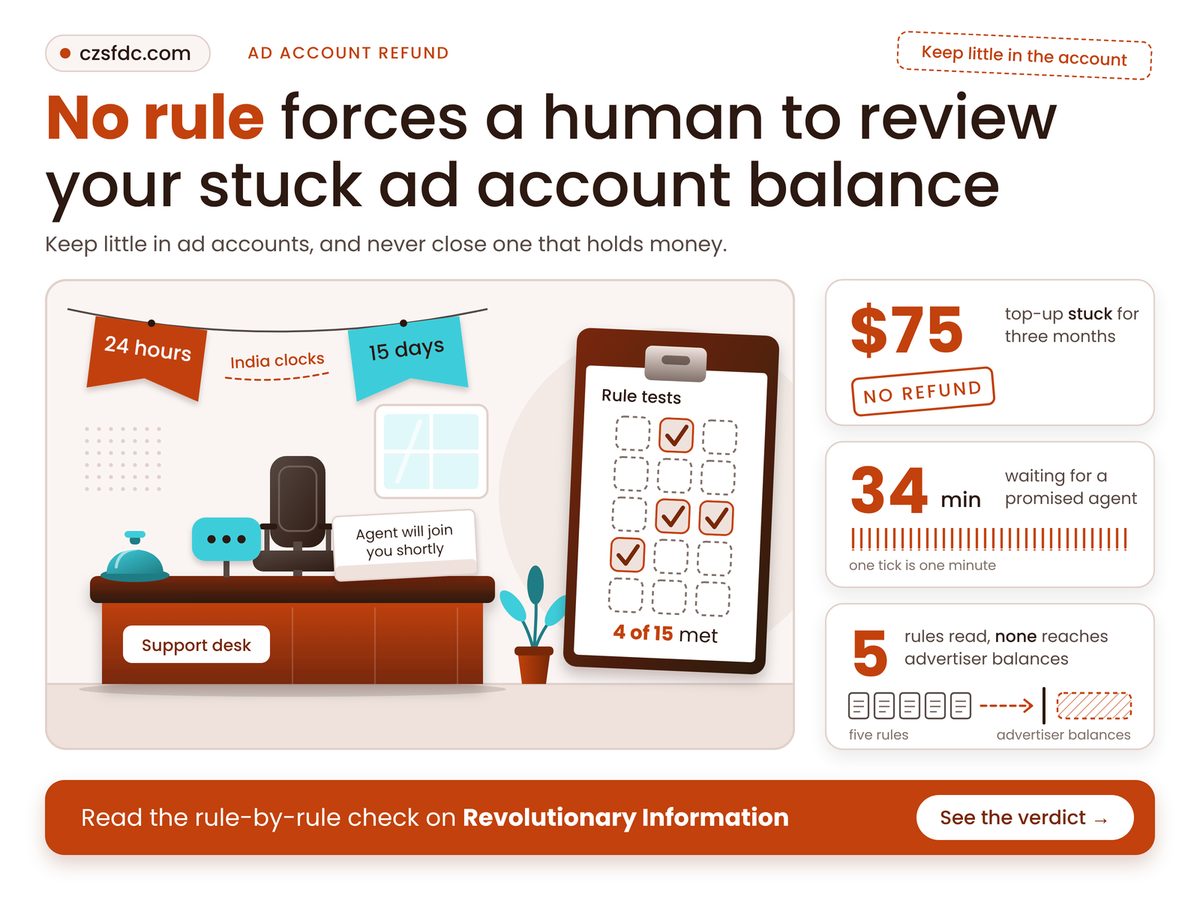
Yes: a platform that holds your money should owe you a human when its bot cannot settle a payment dispute, and no rule we read makes ad platforms do it.
- EU law demands human review when you contest an account closure, but not of the balance left behind.
- Before closing an ad account, get a person to confirm in writing where the balance goes.
- Keep top-ups near what you will spend soon. The lost interest is trivial; the dead end is not.
Why does an ad account refund need a person?
A bot that can only close accounts cannot weigh an exception, and a closed account leaves the money with nobody to chase it, so a person has to review the dispute.
The owner of this site runs two Meta ad accounts and reports that a $75 top-up landed in the wrong one. Automated support said the only option was to close the account, with the balance refunded automatically. Only an AI assistant was reachable, so the owner closed it. Three months on, no refund has arrived, and a new AI ticket says the payment mode is non-refundable. That is the owner's account, unconfirmed by Meta; its own pages blocked our reader, so we could not check them.
In January 2026, PPC Land reported an advertiser whose Meta chat said 'We're connecting you with an agent who can continue to provide the help you need.' Per the report, no agent joined and Meta did not comment. One case is not a rate, but it shows the loop.
On 2 November 2026 a Meta Verified subscriber wrote on Meta's community forum that paid support gave them a chatbot, and asked for 'A real support representative, not another chatbot.' One voice, a consumer product, but the same company and failure.
Four figures size the gap: a wait, an interest cost, a rule count and a ratio. PPC Land supplied the wait; we did the rest. Statutes can write a clock when they want to, as the CRA reporting clock for vendors shows.
Wait for a Promised Agent
34 minutes
No agent ever joined the chat
Interest Lost on $75
$1.12
Derived at 6%, so small
Rules Read for This Piece
5 rules
Two force a human, none a refund
Wait vs India's 15-Day Rule
6 times
Derived: days stuck over 15
Take the interest figure. It is tiny, or rather tiny to everyone except the person it belongs to. Only an obligation with a date on it moves a balance that small, and we would keep our own paper trail, the logic behind a year of audit-log retention.
A rule that guarantees a human for the closure but not for the money left behind protects the bot, not the advertiser.
Is there a law that gives you the right to talk to a human?
Partly: EU law gives a right to a human on request for distance financial services, and a human check on complaint decisions about accounts, but no rule we read covers an advertiser's stuck balance.
We checked Directive (EU) 2023/2673, the Digital Services Act, Regulation (EU) 2019/1150, India's IT Rules 2021 and E-Commerce Rules 2020 on three tests: does the text force a human, cover a payment dispute, and reach a business buyer? This is our reading, not legal advice.
| Rule | Forces | Stops short |
|---|---|---|
| ⚖️ EU 2023/2673 | Human on request, from 19 Jun 2026 | Financial services; ad top-ups likely outside |
| 🛠 EU DSA | No fully automated complaint decisions (Art 20) | Covers account closure, not the money left |
| 🌍 EU 2019/1150 | Complaint system for business users (Art 11) | Carves out some ad tools, Art 1(3) |
| ⏱ India 2021 | Acknowledge in 24 hours, resolve in 15 days | A clock; we saw no human-review duty |
| 🧾 India 2020 | Acknowledge in 48 hours, redress in one month | Consumers only; business buyers likely outside |
Each rule stops one step short of the balance: the EU gives a human for the closure, not the money left; India gives a clock, probably not to business buyers. The CFPB's June 2023 report on consumer-finance chatbots names customers left without an 'offramp to a human customer service representative', but it is a report, not a rule.
Only four of fifteen checks come out yes, so an advertiser with a stuck balance has no rule to cite for a human. Derived by us from five rules.
Worked example: take the owner's case on three assumptions: a $75 balance, three months counted as 91 days, and a 6% yearly rate for idle money. With simple interest on calendar days, 75 × 0.06 × 91 ÷ 365 = $1.12. That wait is 76 days past India's 15-day clock. Try your own balance and days below.
Does a human duty on payment disputes scale?
In our view the objection overreaches, because a duty that applies only to payment disputes the bot has already failed to settle, and only on request, is far narrower than staffing every chat.
The law already draws this line narrowly. Article 16d gives a consumer 'a right to request and to obtain human intervention' when a trader uses online tools; the Digital Services Act bars complaint decisions made 'solely on the basis of automated means'. Both trigger on request or complaint.
A second objection is fraud. But review is not payout: a person can still refuse. We made the compulsory-versus-voluntary case in our look at the default password ban and why labels fail.
One grey area, and it is opinion: should a business buyer get a consumer's redress? We think a prepaid balance deserves it.
- Closing on a bot's instruction can leave you with no account to complain from; ask in writing what happens to the balance first.
- Check a promised refund against your card statement; card issuers set their own dispute windows.
- Keep every transcript and screenshot yourself. A platform's retention is its choice.
Check these about your own account
- A balance sits in a closed or restricted account.
- Support offers only a chat that promises an agent and never delivers.
- You paid as a business, so consumer redress may not cover you.
- The platform, not you, suspended or closed the account.
The decision this week is how much money you leave sitting in any ad account. Keep it near what you will spend soon, and never close an account that holds a balance until a person confirms in writing where it goes. If a balance is already stuck, send one written complaint naming the amount and every ticket number, and ask for a human reviewer; if the platform closed your EU account, cite Article 20 of the Digital Services Act. This fails where a small top-up would stall a campaign, so check your billing threshold first. Next read: security.txt and who compels it.
How we checked this
We read Directive 2023/2673 (28 November 2023), Regulation 2022/2065 Article 20 (27 October 2022) and India's E-Commerce Rules 2020 on 6 November 2026. The worked example assumes a $75 balance, 91 days and a 6% rate. Meta's own pages blocked our reader and were not read. No product was tested hands-on for this article. Last verified: 6 November 2026. Edited by Sheftali, reviewed after publication. Spotted something out of date? Tell us and we will correct it.
No comments
Post a Comment