Wednesday, August 19, 2026

Why Every AI Agent In Your Company Needs An Identity

At 2:14 on a Tuesday morning, an internal agent at a mid-sized logistics firm opened a support ticket, pulled a customer export, and pushed a config change to staging. Every one of those actions was permitted. Nobody could say who permitted them. The token it used belonged to a service account created in 2023 by an engineer who left the company in 2024, and the audit log recorded the actor as "automation-prod-07".

That is not a security failure in the way most boards understand the phrase. Nothing was breached. The system worked exactly as configured. It is an accountability failure, and it is now sitting inside a standards process at NIST rather than inside a vendor pitch deck.
Why Every AI Agent In Your Company Needs An Identity

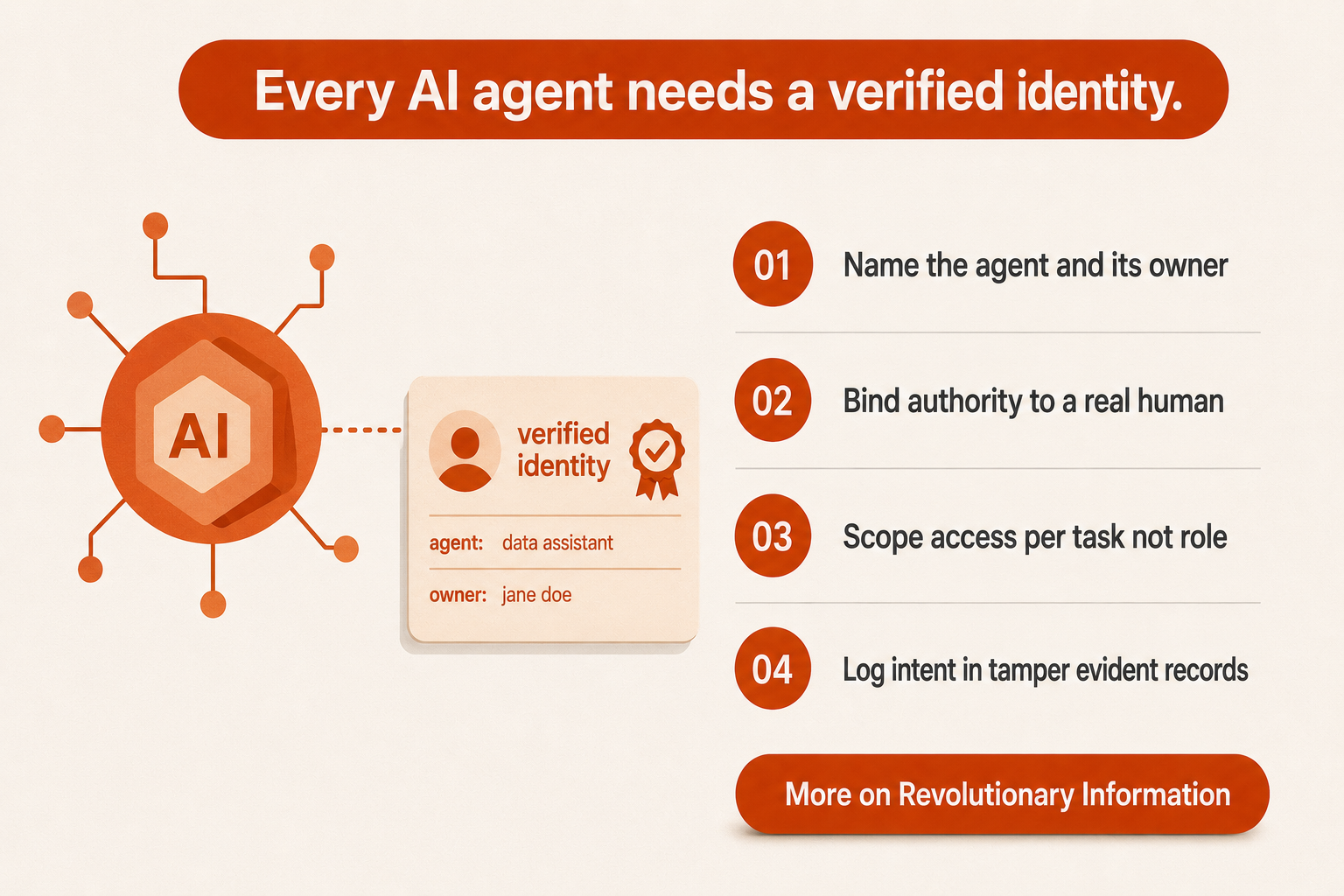
AI agents are getting production access faster than anyone is issuing them identities. NIST opened a formal track on agent identity and authorization in February 2026. Enterprises that cannot name the human behind an agent action will fail their next audit, not their next penetration test.

Why this matters now

The industry already solved machine identity once. Workloads got certificates and CI runners got short-lived tokens, and everyone quietly agreed that a long-lived API key sitting in a repository was embarrassing. That model holds because a workload does one thing forever. An agent does not. It decides. It picks which tool to call and when to escalate. The thing it decides to do at 2am was not in the ticket that authorized it.

So the common advice, which is to give each agent a service account and move on, is wrong. Not slightly wrong. A service account answers "what is running." Agent identity has to answer four questions instead, and NIST wrote them down almost that plainly: what exactly is the agent, who delegated authority to it, what is it allowed to do, and how are its actions logged and constrained. The governance frameworks that decide which enterprises win with agents all assume those four answers exist. Almost nobody has them.

In February 2026 NIST's Center for AI Standards and Innovation announced the AI Agent Standards Initiative, with agent security and identity as one of three named workstreams. Alongside it the National Cybersecurity Center of Excellence published a draft concept paper, "Accelerating the Adoption of Software and AI Agent Identity and Authorization," and closed public comment on 2 April 2026. It does not invent a protocol. It stretches the ones already in the building: OAuth 2.1, OpenID Connect, SPIFFE and SPIRE for workload attestation, SCIM for lifecycle, NGAC for attribute-based access, and the Model Context Protocol for tool access. And it is blunt about the part vendors skip, asking how to bind agent identity to human identity for on-behalf-of scenarios, and demanding that agents log their actions and intent in a tamper-proof and verifiable manner. Meanwhile the credential surface underneath all of this keeps expanding, and the certificate rules governing it keep tightening on a schedule that has nothing to do with AI and no interest in waiting for it, which is the same structural pressure driving the post-quantum migration deadlines already running against your encrypted traffic.

Certificate lifetime

200 days

Ceiling since 15 March 2026

Shadow AI breach premium

USD 670,000

Added to average breach cost

Secrets leaked publicly

28.65 million

New on public GitHub in 2025

Machine to human ratio

109 to 1

Identities per employee today

The certificate number is the one that should worry an operations lead, because it is the only figure on that grid that is a hard deadline rather than a trend. The ceiling drops again in March 2027 and lands under seven weeks in March 2029, and at that point the window for reusing domain validation data shrinks to ten days. Manual renewal stops being slow and starts being impossible. Any agent that terminates or initiates TLS on your behalf inherits that clock, and if you cannot enumerate which agents hold which credentials, you cannot rotate them on the schedule the rules now require.

"

You are running more than a hundred non-human actors for every person on payroll, and almost none of them can tell you which human signed off on what they did last night.

What identity for an agent actually means

Strip away the protocol names and agent identity decomposes into six practical obligations. None of them is exotic. All of them are things your existing IAM stack does for humans and mostly fails to do for software that makes choices. The table below is the working checklist, and it is deliberately written as what you have to be able to prove, not what you have to buy.

Category Detail Insight
Identification Model, version, tool set, owning team A name is not an identity
Authentication Attested workload credentials, not static keys Short lived beats secret and shared
Delegation On-behalf-of chain back to a person Authority must have a human origin
Authorization Scope bound to task, not role Least privilege per job, per run
Audit Tamper-evident record of action and intent Non-repudiation is the actual deliverable
Lifecycle Provisioning, rotation, revocation on exit Kill it faster than you built it

Read down the Insight column and the pattern is uncomfortable. Five of the six obligations are things you can implement today with protocols that shipped years ago. Only the audit row really needs new work, because logging an agent's intent, meaning why it chose the action, is not something any existing standard captures well. That is where the standards effort will actually spend its time, and it is also the row your regulator will ask about first.

17 Feb 2026 · 9 Mar 2026 · 2 Apr 2026 · Next · Initiative announced · Security RFI closes · Identity comments close · Project description

The NIST agent identity track moved from announcement to closed comment periods in seven weeks during early 2026, and the next milestone is a draft project description rather than a finished standard.

Where this breaks in practice

The first breakage is organisational, not technical. Identity lives with the security team, agents live with the platform or data team, and the person who actually authorized the agent to touch a customer record is a product manager who has never seen an IAM console. Palo Alto Networks' 2026 identity security survey of more than 2,900 security decision-makers found that disconnected identity systems add roughly 12 hours to the average identity-related incident. That gap is not spent fixing anything. It is spent asking who owns this thing.

The second breakage is that agents multiply credentials as a side effect of being useful. Every tool an agent connects to wants a key. Every connector config file becomes a place a key can sit. This is the same failure pattern that made verified caller identity such a fight in telecom, where operators had to be pushed into displaying the KYC name behind a number before anyone could trust who was calling. The lesson transferred badly. We are once again shipping systems that act on our behalf without a verified name attached.

And here is the part I am not sure about, which is worth saying out loud rather than hiding behind a framework. Should an agent hold a first-class identity of its own, or should it only ever borrow a human's? Giving it its own identity makes revocation clean and audit trails honest, but it also creates a permanent non-human principal that outlives the reason it existed. Borrowing keeps accountability tight and makes the agent disappear when the human leaves, but it collapses the moment an agent runs unattended for a week. I lean toward first-class identity with a mandatory delegation link, but I would not call that settled, and anyone selling you certainty on this in 2026 is selling.

Watch-outs before you buy anything:

  • Any vendor claiming NIST compliance for agent identity is claiming compliance with a concept paper. There is no standard to comply with yet.
  • Inventory before policy. If you cannot list every agent and the credentials it holds, a policy engine just enforces rules against the half you know about.
  • Logging the action without logging the delegation is worthless. "Agent X deleted the record" is not an audit trail. "Agent X, acting for Priya, deleted the record under ticket 4471" is.
  • Treat agent credentials as in-scope for your certificate automation programme now, not after the next validity cut lands.

Key takeaways

01. Access control, not model quality, is where agent deployments fail. IBM's 2025 breach research found 97% of breached organisations that suffered an AI-related security incident said they lacked proper AI access controls.

02. The credential surface is growing faster than the agents are. Leaked AI-service secrets on public repositories rose 81% year over year in GitGuardian's 2026 count, outpacing the overall secrets growth rate.

03. Start with the delegation link. It is the only obligation on the checklist that no tool can retrofit for you, because the record of who authorized what has to be captured at the moment it happens.

Pick your three highest-privilege agents this week, and for each one write down the human who authorized it, the exact scope it holds, and where its actions are logged. If you cannot complete that sentence for all three, you do not have an agent identity problem to plan for later. You have one now, and it is already in production.

Saturday, August 1, 2026

Harvest Now Decrypt Later: Your Encrypted Data Is Already Stolen

A batch of your company's traffic left the building this morning. It was encrypted, so nobody logged it as an incident. And somewhere it may now be sitting on a disk in a facility you will never see, waiting. Not for a stolen password. For a machine that does not exist yet.

Harvest Now Decrypt Later: Your Encrypted Data Is Already Stolen

Attackers are storing encrypted traffic today to decrypt once quantum hardware matures. NIST has already set the clock: RSA and elliptic curve go deprecated after 2030 and disallowed after 2035. Data with a long confidentiality life is exposed now, not later. Start the inventory this quarter.

Why It Matters

The attack has a name that sounds almost polite. Harvest now, decrypt later. An adversary, usually state-sponsored, quietly copies encrypted traffic and archives it. No malware, no ransom note, no alert. They are not trying to read it this year. They are betting that a cryptographically relevant quantum computer arrives before the value of that data expires, and for a lot of records that bet is a comfortable one.

Here is where most security budgets get it wrong. Teams treat post-quantum work as a 2030 problem because that is the first date on the NIST calendar, and 2030 feels like somebody else's fiscal year. But the exposure window opened the day the traffic was captured, not the day it gets decrypted. If you handle records that must stay confidential for fifteen years, your deadline already passed. I would go further: for anything covered by long-retention regulation, the decision to defer migration is a decision to accept an eventual breach, just one you will not have to explain until after you have left the job. That is a governance failure dressed up as a scheduling call, and it belongs on the same risk register as the accountability gaps in enterprise AI agent deployments that boards spent the first half of this year arguing about.

The hardware side is no longer speculative either. Banks and pharmaceutical firms are already buying processing time on commercial systems, a shift covered in more detail in this breakdown of what quantum computing actually means for business leaders. Nobody serious claims a machine can break RSA-2048 today. The point is that the archive does not care about today.

Money makes the scale legible in a way that threat modelling never does. Look at what one government alone expects to spend just to swap its own algorithms.

Final Deadline

2035

Legacy algorithms fully disallowed

Federal Migration Cost

$7.1 billion

Civilian agencies only, excludes defence

Practitioners Surveyed

4,000+

IT and security roles worldwide

Actively Preparing

38%

Down from the prior year

The cost estimate comes from the congressionally mandated OMB and ONCD report to Congress, covering United States federal civilian systems in 2024 dollars (as of 2024). It deliberately leaves out national security systems and the entire commercial sector. Read it as a floor, not a ceiling. What it really measures is not licence fees but archaeology: the labour of finding every place a cryptographic primitive was hardcoded by someone who left in 2014. The preparation rate, drawn from the 2026 Entrust and Ponemon Institute global study, moved the wrong way against the prior year, which tells you budget pressure is beating deadline pressure right now.

One government put $7.1 billion against swapping its own algorithms, and that estimate covers civilian systems alone. Whatever your number is, you have not budgeted it yet.

The standards themselves are settled, so the usual excuse about waiting for the technology to mature no longer holds. Here is the state of play.

Category Detail Insight
The standards FIPS 203 (ML-KEM), FIPS 204 (ML-DSA), FIPS 205 (SLH-DSA) Finalised in 2024, ready to deploy
Deprecation date RSA, ECDH, ECDSA, DSA and FFDH deprecated after 2030 Continued use needs documented risk justification
Certificate visibility 43% report full insight into their own certificates Most teams cannot see what breaks
Operational pain 68% call managing cryptographic assets extremely difficult A tooling gap, not awareness gap
Highest-risk data Regulated records, intellectual property, health data, identity records Confidentiality outlives the encryption protecting it
The attack Collection is passive and leaves no trace on your network No breach alarm ever fires

Read that table as a sequencing document. Rows three and four are the real project; rows one and two are the easy part everyone talks about instead. So why is the work stalling? The reasons people actually give are boring, and boring reasons are the ones that win.

What is actually blocking migration Budget 39% Expertise 38%

Budget was cited by 39% of respondents and missing expertise by 38%, both up sharply on the prior year in the same Entrust and Ponemon study.

Friction Points

The migration itself is not the hard part. Swapping a TLS library is a Tuesday. Finding every system that quietly depends on a certificate nobody documented is a two-year archaeological dig, and that discovery work is what the money is really paying for. Every embedded device, every code-signing key, every hardware security module, every vendor integration where the crypto lives on their side of the contract and not yours.

There is one question nobody in this field can answer honestly, and it deserves saying plainly rather than hiding behind a confidence interval. Nobody knows when a cryptographically relevant quantum computer arrives. Estimates run from the early 2030s to never. That uncertainty is not a reason to wait, it is the reason the deadline exists at all: regulators picked 2035 precisely because the honest answer is a shrug, and a shrug is not something you can build a control around. Reasonable, well-informed people disagree about this, and they will keep disagreeing right up until somebody publishes a result.

Practical watch-outs before you scope the work:

  • Vendor claims of being quantum-ready usually mean the product supports a hybrid mode, not that your deployment uses it. Ask which algorithm is negotiated in production.
  • Certificate lifetimes are shrinking independently of quantum concerns. If your renewal process is manual, that breaks first, and it breaks loudly.
  • Long-lived signing keys, especially firmware and code-signing, are worse than transport encryption. You cannot re-sign a device already in a customer's hands.
  • Regulatory sequencing bites. Mandated technical standards land on their own timetable regardless of your roadmap, a pattern already visible in fights over mandating universal OBD access across car brands.
  • Data you already sent is not covered by anything you do next. Migration protects future traffic only.

Key Takeaways

  • Inventory before you migrate. You cannot replace an algorithm you have not located, and the discovery phase dominates the timeline.
  • Rank by confidentiality lifetime, not by system importance. A dull archive of health records outranks a busy internal dashboard.
  • Build crypto-agility, not a one-time swap. Whatever replaces today's choice will itself need replacing, and the second migration should cost a fraction of the first.
  • Put the risk acceptance in writing now. After the deprecation date, that documentation stops being optional, and drafting it late is how audits go badly.

Pull your certificate inventory this quarter and sort it by how long each dataset has to stay secret, not by how busy the system is. That single sorted list is the whole project plan, and the teams that have one are already ahead of the clear majority who have not started.

Monday, July 13, 2026

Why AI Agent Governance Decides Which Enterprises Win In 2026

Most companies buying autonomous AI agents right now have no clean way to switch one off. They are wiring software that acts on its own into billing systems, customer inboxes, and supply chains, then discovering after the fact that nobody owns the controls. The technology arrived years before the rulebook, and that gap is where the money leaks. AI agent governance is the unglamorous discipline that decides which of these deployments prints returns and which quietly gets pulled.

Enterprises are rushing autonomous AI agents into production while skipping the controls that keep them safe and accountable. The winners this year are not the fastest adopters. They are the ones who paired agents with real oversight, kill switches, and audit trails before scaling anything.

Why It Matters

An AI agent is not a chatbot that answers a question and stops. It takes a goal, breaks it into steps, calls tools and other software, and keeps acting until it decides the job is finished. That autonomy is the whole point, and also the whole problem. A chatbot that hallucinates wastes a few minutes; an agent that hallucinates can send the wrong invoice, cancel the wrong order, or push data to the wrong recipient before a human looks up. That is why AI agent governance has moved from a compliance footnote to a board-level question.

Why AI Agent Governance Decides Which Enterprises Win In 2026

The adoption curve is close to vertical. Gartner projects that by the end of 2026 a large share of enterprise applications will ship with task-specific agents built in, a steep jump from the year before. Low-code builders now let a team stand up a working agent over a lunch break, so the constraint is no longer engineering talent. The real constraint is whether anyone can see what these agents do once they are live, and whether the payoff justifies the exposure.

Low-code build time
15–60 min
Per agent, low-code tools
US production ROI
192%
Median, scaled deployments
Enterprise apps by 2026
40%
Embedding task-specific agents
In production today
1 in 9
Enterprises actually running agents

The build-time figure is the quiet trap. When spinning up an agent takes minutes, teams create dozens of them informally, and the organization loses count of how many are running against production data. That is exactly the condition that turns a helpful tool into an unmonitored liability, and it happens without a single approval meeting. The gap between the number of agents deployed and the number anyone is actually watching is where most of the risk quietly accumulates.

None of this means agents fail to pay off. Disciplined programs post real returns, and the business case for automating repetitive, rules-heavy work is genuine. The difference between a program that scales and one that stalls comes down to a handful of measurable gaps rather than the quality of the underlying model. The current numbers on those gaps are not comforting, and they explain why so many pilots never graduate into trusted production systems.

CategoryDetail (2026)Why It Matters
Adoption intent74% plan agentic AI within two years (Deloitte)Demand is racing ahead of control
Governance maturityOnly 21% have a mature agent-governance modelMost run agents without real guardrails
Kill-switch readiness35% could not stop a rogue agentNo off-switch when things go wrong
Trust maturity~30% reach advanced governance maturity (McKinsey)Few have audited, controlled pipelines
2025 baselineUnder 5% of enterprise apps embedded agents in 2025Shows how steep this curve is

Read those rows together and a pattern appears: intent is nearly universal, control is rare. Closing that distance, not buying more agents, is the actual work of AI agent governance.

A workable sequence for teams starting now: catalog every agent, wrap each one in hard limits and a kill switch, then log and monitor it without gaps. That order is the pattern behind the roughly 171% median return that production-scale programs report globally.

Friction Points

Standing up controls is harder than buying the agents, and the obstacles are practical rather than philosophical. Each one is survivable on its own; the danger is letting several pile up unnoticed until an incident forces the issue.

  • Shadow agents: teams deploy agents without telling IT, so no inventory ever reflects what is actually running.
  • No clean stop: many systems cannot halt an agent mid-task without taking the whole workflow down with it.
  • Ownership vacuum: when an agent errs, security, legal, and the business each assume another team is accountable.
  • Audit blindness: agents chain many tool calls, and without logging, reconstructing what happened later is guesswork.

These are fixable, but only if controls are treated as a launch requirement instead of a cleanup project. Bolting oversight onto an agent that already touches customer data is slower, costlier, and far harder to push through politically once something has gone wrong.

Before approving the next agent, ask one question: if this thing goes wrong at 2 a.m., who stops it and how? If nobody in the room can answer, you do not have a deployment plan, you have an incident waiting for a date. Build the controls first, then scale.

Sunday, April 26, 2026

Quantum Computing Explained for Business Leaders in 2026

Corporate boards spent the last five years chasing generative AI, entirely missing the actual mathematical revolution quietly being built in sub-zero server racks. Quantum computing is no longer a theoretical physics project confined to university basements. It is a commercial weapon. Banks, pharmaceutical giants, and global logistics firms are actively buying up processing time in 2026 to solve complex industrial problems that would literally take standard supercomputers thousands of years to crack.

Quantum computing replaces binary bits with qubits, processing massive datasets simultaneously rather than sequentially. By 2026, it is actively accelerating drug discovery and financial modeling. Businesses must adopt post-quantum encryption immediately, as these machines will soon easily crack classical cybersecurity defenses.

The Mechanics Without The Math

To grasp quantum computing for non-physicists, you have to forget how your current laptop works. Classical computers think in binary—ones and zeros, yes or no. A quantum system uses qubits, which leverage a property called superposition. They can be a one, a zero, or both at the exact same time. Think of a classical computer like a person trying to find the exit in a maze by walking down every single path one by one until they escape. A quantum computer floods the maze with water, finding the exit instantly by exploring every possible route simultaneously.

Then there is entanglement. When qubits become entangled, changing the state of one instantly changes the state of another, even if they are physically separated. This allows systems to process wildly complex, interconnected variables without slowing down. According to a February 2026 Boston Consulting Group analysis, early adopters in global shipping are using these systems to recalculate supply chain routes on the fly, saving ₹45,000 in monthly cloud computing waste while solving routing variables that would take a standard MacBook three wasted Sundays a year to process.

Quantum Computing Explained for Business Leaders in 2026

The financial sector is not waiting around. Hedge funds are running Monte Carlo risk simulations in fractions of a second. Pharmaceutical companies are modeling molecular interactions without physical petri dishes. And it goes far beyond logistics. Material science is experiencing a similar renaissance. Instead of mixing physical chemicals and waiting to see if a new battery compound catches fire, engineers simulate the atomic behavior flawlessly in a digital environment. We are entering an era where physical prototyping is replaced by absolute mathematical certainty. This level of computational velocity breaks the basic constraints of modern business, fundamentally altering who wins and who loses in data-heavy industries. The metrics defining this shift are no longer theoretical predictions; they are hard operational realities.

Molecule Simulation
14 Hours
2025 MIT study benchmark
Enterprise Spending
$4.2 Billion
2026 Gartner market projection
Processing Scale
1,121 Qubits
Current peak hardware capability
Post-Quantum Testing
88%
Fortune 500 banks (2026)

Those 14-hour simulation turnarounds highlight a brutal divide. If your competitors can finalize a new chemical compound in an afternoon instead of running a multi-year physical trial, your traditional R&D department is entirely obsolete. You cannot compete on a classical timeline against an opponent bending the rules of computational physics.

The Cybersecurity Time Bomb

The most terrifying aspect of this leap forward is what it means for digital security. Almost all modern encryption relies on mathematical problems that are too tedious for classical computers to solve in a reasonable timeframe. A standard RSA encryption key would take millions of years to crack. A mature quantum machine running Shor's algorithm will shatter it in an afternoon. This eventuality is known as Q-Day. Bad actors are already harvesting encrypted corporate data today, storing it in server farms, and waiting for the hardware to mature so they can decrypt it tomorrow.

Exactly when a bad actor will use a mature quantum system to drain a centralized bank ledger is genuinely unknown. The timeline is fuzzy, but the math guarantees it will happen. The National Institute of Standards and Technology (NIST) finalized the first post-quantum cryptography standards (as of 2024), and full migration is now an active mandate for any entity handling sensitive financial or personal data.

Evaluating the immediate ripple effects of this technological shift reveals both massive operational savings and severe infrastructural demands that companies must navigate right now.

Category 2026 Detail Why It Matters
Cryptography Timeline Q-Day estimated by 2030 (CISA 2025 report) When current encryption breaks entirely.
Logistics Savings 12.5% fuel reduction on global shipping lines (2026 Maersk pilot) Massive reduction in operational overhead.
Talent Availability 1 qualified engineer for every 45 open roles (2025 IEEE survey) Hiring costs will be astronomical.
Physical Infrastructure Systems operate at -460°F (-273°C) Requires massive specialized facility upgrades.
Cloud Accessibility 6 major cloud providers offer remote access You rent it, you don't build it.

Migrating to these quantum-resistant algorithms is not a simple software patch. It is a fundamental rewrite of network architectures. Ignoring this reality is corporate negligence at this stage.

Adoption Friction and Commercial Reality

You cannot just buy one of these machines and stick it in your server room. They are notoriously unstable and require operating conditions colder than deep space to function. Any slight change in temperature or electromagnetic interference causes a phenomenon called decoherence, where the qubits lose their state and output garbage data. This error rate is the biggest bottleneck facing the industry today.

  • Error Correction Tax: Current systems require hundreds of physical qubits just to sustain one reliable, logical qubit. This limits the size of the problems they can actively solve without crashing.
  • Integration Nightmares: Legacy databases cannot talk directly to quantum processors. Companies must build bespoke hybrid pipelines where classical servers handle basic tasks and outsource specific heavy calculations to the specialized cloud.
  • The Knowledge Gap: Writing code for these machines requires understanding non-binary logic gates. Your senior software developers are essentially back at square one, learning a completely alien programming language.

Because of these hurdles, outright ownership is extremely rare. The business model has shifted almost entirely to Quantum-as-a-Service (QaaS). You rent time on machines maintained by tech giants. This democratizes access but creates intense competition for processing windows. And there is the sheer cost of entry. Renting processing time is not cheap. Businesses must conduct rigorous cost-benefit analyses to determine if the speed gained justifies the massive hourly rental rates charged by top-tier providers.

The Strategic Mandate

Your business does not need to hire a theoretical physicist tomorrow. You do need a task force to audit your current data encryption standards and identify which operational bottlenecks are purely computational. The companies that survive the next decade will be the ones that stop treating this technology as science fiction and start treating it as the new baseline for industrial speed.

Saturday, March 21, 2026

Why Short Video Feeds need Strict Regulation and restriction

The infinite scroll of short-form videos is engineering a global attention crisis that affects both adults and children. Tech giants have weaponized dopamine loops to hijack human psychology, turning casual browsing into hours of unconscious ghost scrolling. This unchecked algorithmic feed is actively destroying our ability to focus on mundane daily tasks, read books, or engage in deep work. Self-control is no longer a viable defense against billion-dollar behavioral algorithms designed to keep you trapped on screen. This deep-dive exposes the exact mechanics behind digital addiction and explains why immediate government intervention is the only realistic solution. We break down the necessity of mandatory, hard-coded daily time limits at the device or account level to protect public mental health. Readers will understand the psychological triggers these platforms exploit and learn the structural changes required to reclaim their cognitive freedom from predatory tech companies.

The Infinite Slot Machine in Your Pocket

You sat down on the edge of your bed at 10:15 PM to set a morning alarm. At 11:40 PM, you are still staring at a glowing screen, watching a stranger power-wash a driveway, completely unaware of where the last 85 minutes went. Your eyes are dry. Your neck aches. You did not consciously choose to watch a movie or read a long article. You simply fell into a trance. This is ghost scrolling, and it is not a personal failing on your part. It is a deliberate, highly engineered feature of modern software architecture. Platforms have realized that the most profitable human state is mild, persistent hypnosis. They are actively stealing your sleep, your focus, and your children’s cognitive development to inflate their quarterly ad revenue.

And no amount of willpower can beat a supercomputer.

The Bitter Truth About the Endless Scroll

The algorithmic feed is not entertainment; it is behavioral engineering. By weaponizing human psychology, tech giants bypass our self-control to maximize daily active user metrics. Without strict, government-mandated daily time limits imposed at the device level, this unchecked exploitation will continue to artificially manufacture a massive, global attention span deficit.

Why Your Brain Cannot Look Away

Think about how we used to consume media, much like ordering a meal at a restaurant. You pick a two-hour movie, you sit down, you consume a defined piece of art, and when the credits roll, the plate is empty. The experience has a natural, physical stopping cue. The current era of micro-content operates entirely differently. It is like standing in front of a factory conveyor belt that shoots a highly flavored, chemically engineered potato chip into your mouth every fifteen seconds. You never get full. You never receive a neurological signal to stop eating. The bag literally never ends.

Why Short Video Feeds need Strict Regulation and restriction

Because the reward is entirely unpredictable, your brain enters a state of high alert. Every upward swipe of the thumb is a pull on a casino slot machine lever. You might get a boring clip of someone dancing, or you might get a highly stimulating, perfectly curated piece of content that triggers a massive chemical spike. This intermittent reinforcement forms a vicious dopamine loop that rewires how you experience satisfaction. Your brain stops looking for the actual video and simply becomes addicted to the physical act of swiping. When you subject a child's developing brain to this constant, rapid-fire stimulation, it fundamentally alters their baseline for engagement. Normal day-to-day things like reading a textbook, waiting in line, or having a slow conversation suddenly feel physically painful. They literally lack the neurological maturity to fight off a billion-dollar machine learning model.

There is an undeniable grey area here. We cannot pretend that every single 15-second clip is a societal hazard. Sometimes you just want to see a funny dog or learn a faster way to chop an onion, and finding the exact legislative line between harmless digital well-being and predatory addiction is messy. Not all fast content is evil. But the delivery mechanism—the frictionless, auto-playing infinite void—is actively hostile to human productivity.

Tech companies employ thousands of behavioral psychologists whose sole job is to remove every ounce of friction from your screen. They hide the clock. They hide your phone's battery indicator while the video plays. They remove the need to click "next." They have erased the natural boundaries of time, leaving you stranded in a hyper-stimulating purgatory.

The Illusion of Choice vs. Algorithmic Control

Reality Metric

The User's Perception

The Platform's Actual Design

Content Selection

I am choosing what I want to watch.

The machine feeds you what keeps you paralyzed the longest.

The Stopping Cue

I will just watch three more and go to sleep.

Infinite auto-play guarantees there is no logical exit point.

Child Safety

Kids are just watching funny trends.

Minors are being fed radicalizing, high-anxiety content for engagement.

The End Goal

Entertainment and connection.

Extracting maximum seconds of human attention to sell to advertisers.

Where Self-Regulation Fails Completely

Asking people to simply "put the phone down" ignores the reality of modern addiction mechanics. We need aggressive platform regulation because the internal tools provided by tech companies are entirely performative.

  • The Joke of "Screen Time" Limits
    • Built-in operating system limits are effectively useless.
    • When a prompt appears saying "You have reached your 30-minute limit," it is always accompanied by an "Ignore for today" button.
    • A child will instantly click that button 100% of the time, rendering the entire feature meaningless.
  • The Failure of Account-Level Separation
    • Creating "Kids" accounts does not solve the core psychological manipulation.
    • Platforms just serve the exact same rapid-fire slot machine mechanics, replacing adult content with bright colors and loud noises.
    • The structural damage to the child's attention span remains identical.
  • The Weaponization of Boredom
    • We have forgotten how to be bored.
    • The second we face a moment of silence at a red light or in an elevator, we panic and reach for the feed.
    • This constant stream of noise prevents the brain from entering the default mode network, which is where creativity and problem-solving actually happen.
  • The Legislative Cowardice
    • Governments currently treat these platforms like neutral public squares instead of engineered casinos.
    • Lawmakers focus entirely on data privacy while ignoring the massive psychological damage inflicted by the user interface itself.

The Only Mathematical Way Out

We must treat the endless scroll with the exact same regulatory hostility we apply to gambling and tobacco. Governments need to mandate strict API-level changes that force platforms to implement hard-coded, unbypassable daily caps on rapid-feed consumption. If an account reaches forty-five minutes of vertical scrolling, the feed must physically lock. No bypass buttons. No parent overrides. The app simply stops serving content until midnight. Delete the social media applications off your phone today and force yourself to log in through a slow, clunky mobile web browser. The added friction will save your brain.

Sunday, January 25, 2026

Why ICE Car Brands Must Support Universal OBD

Ever had that sinking feeling when your car suddenly flashes a warning light and you have no clue what’s wrong? You call your mechanic, tow it in, and brace yourself for the bill. Now imagine if you could plug in a small, universal device—right into your car’s onboard diagnostics (OBD) port—and instantly know your clutch health, battery condition, or even which electrical component is about to fail.

That’s the power of a universal OBD (On-Board Diagnostics) device—a tool that could completely redefine how we maintain, monitor, and manage our internal combustion engine (ICE) vehicles. But here’s the catch: most car manufacturers don’t make it easy. And they should.

Let’s dive into why ICE car manufacturers must step up, support universal OBD devices, and empower users to take control of their car’s health like never before.

Why Universal OBD Access Matters for ICE Vehicles 

We live in a world where data drives everything—from our fitness trackers to our smartphones. Yet, when it comes to cars, that same transparency is locked away behind proprietary systems. Universal OBD access could change that. 

Here’s why it’s a game-changer:

  • Empowering Car Owners: A universal OBD system gives users direct insight into their car’s health. Imagine knowing exactly when your alternator is nearing failure instead of waiting for a breakdown. No guesswork, no dependency—just information at your fingertips.
  • Reducing Maintenance Costs: With real-time wear-and-tear insights, owners can service only what’s necessary. This prevents unnecessary part replacements and reduces recurring maintenance costs—especially valuable for high-mileage drivers.
  • Fostering Transparency and Trust: Ever felt unsure whether a workshop’s diagnosis was genuine? A universal OBD system would offer transparent data you can verify yourself. It ensures workshops can’t inflate service costs under the guise of vague “engine issues.”
  • Boosting Used Car Market ValueUniversal diagnostics could help verify a vehicle’s health during resale. Buyers could access objective reports showing battery wear, clutch life, or ECU error history—turning the used car market into a more transparent, trustworthy space.

Why ICE Car Brands Must Support Universal OBD

How OBD Data Can Prevent Critical Component Failures 
A car isn’t just a machine—it’s a complex ecosystem of electrical, mechanical, and digital systems working in harmony. When one fails, the ripple effect can be costly. Universal OBD devices can catch these failures before they snowball. 

Let’s break down how:


The Road Ahead: How Manufacturers Can Enable Universal OBD Support 
Let’s face it—automakers have been gatekeeping OBD data for years. They restrict access to proprietary diagnostic tools, forcing users to depend on service centers. But the road ahead demands collaboration, not control.

Here’s how manufacturers can make universal OBD access a reality:

  • Adopting Open Diagnostic Protocols
    Most OBD-II systems already use standard PID (Parameter ID) formats. Manufacturers could release documentation on proprietary PIDs, enabling third-party devices to interpret them seamlessly.
  • Partnering with Third-Party OBD Developers
    Collaboration between car brands and device manufacturers like Autel or BlueDriver could yield official universal OBDs certified by automakers themselves—ensuring safety and reliability.
  • Integrating Predictive Analytics into ECUs
    By embedding AI-driven predictive models into vehicle ECUs, manufacturers can offer users proactive maintenance alerts right from the dashboard—no workshop visit required.
  • Government and Regulatory Push
    Just as the EU’s “Right to Repair” movement empowers electronics consumers, similar legislation could mandate universal OBD data access. This ensures fair competition and informed vehicle ownership.
Table: Key Benefits of Universal OBD Integration

Aspect

Current Scenario

With Universal OBD Support

Diagnostics Access

Restricted to authorized service centers

Open and accessible to car owners

Maintenance Cost

Higher due to lack of transparency

Reduced via predictive and precise servicing

Component Monitoring

Limited and reactive

Comprehensive and proactive

Resale Transparency

Opaque vehicle condition reporting

Verified digital health reports for buyers/sellers

User Empowerment

Low – reliant on workshops

High – self-diagnostic control


My Final thoughts: The Future of Car Ownership Lies in Transparency

In a world moving swiftly toward electric mobility, ICE vehicles still dominate the roads—and they deserve smarter diagnostic systems. Universal OBD integration isn’t just a tech upgrade; it’s a cultural shift in automotive transparency.

By enabling universal OBD support, manufacturers can build trust, loyalty, and empowerment—three things every car owner craves. It’s not just about fixing what’s broken; it’s about preventing the breakdown in trust between automakers and consumers.

Until that happens, drivers will continue to rely on aftermarket solutions and third-party tools. But the day automakers embrace universal OBDs is the day car ownership finally becomes smarter, cheaper, and fairer for everyone.